In my fifteen years of clinical practice as a Licensed Marriage and Family Therapist, I have sat across from hundreds of well-meaning "gardeners." These are parents, spouses, and friends who operate what I call the Hothouse Dynamic. They enter my office exhausted, presenting a dossier of their loved one's failures, desperate for me to cosign their aggressive management strategies. I recognize this dynamic immediately because, despite my credentials, I am a recovering "fixer" myself. In family systems theory, we identify this behavior not as love, but as anxious enmeshment. When I see potential in my spouse or children, my amygdala - the brain’s fear center - hijacks my behavior. I don’t just want them to succeed; I need them to succeed to regulate my own internal anxiety.
The "fixer" creates a high-pressure environment - a hothouse - designed to maximize output. If a friend is navigating a crisis, we don’t offer a listening ear; we offer a 10-point strategic roadmap by Friday. If a child is socially anxious, we engineer playdates to force exposure. We convince ourselves this is benevolence, but clinically, it is a boundary violation. We are assuming a Locus of Control that does not belong to us. Last autumn, I found myself in this exact cycle with a close friend navigating a faith deconstruction. I bombarded her with apologetics podcasts and daily scripture texts, effectively drowning her agency in my anxiety. She eventually went silent. I was left holding my phone, terrified, realizing I had treated a human soul like a project to be managed rather than a person to be witnessed.
The Biology of Root Rot and Relational Hypoxia
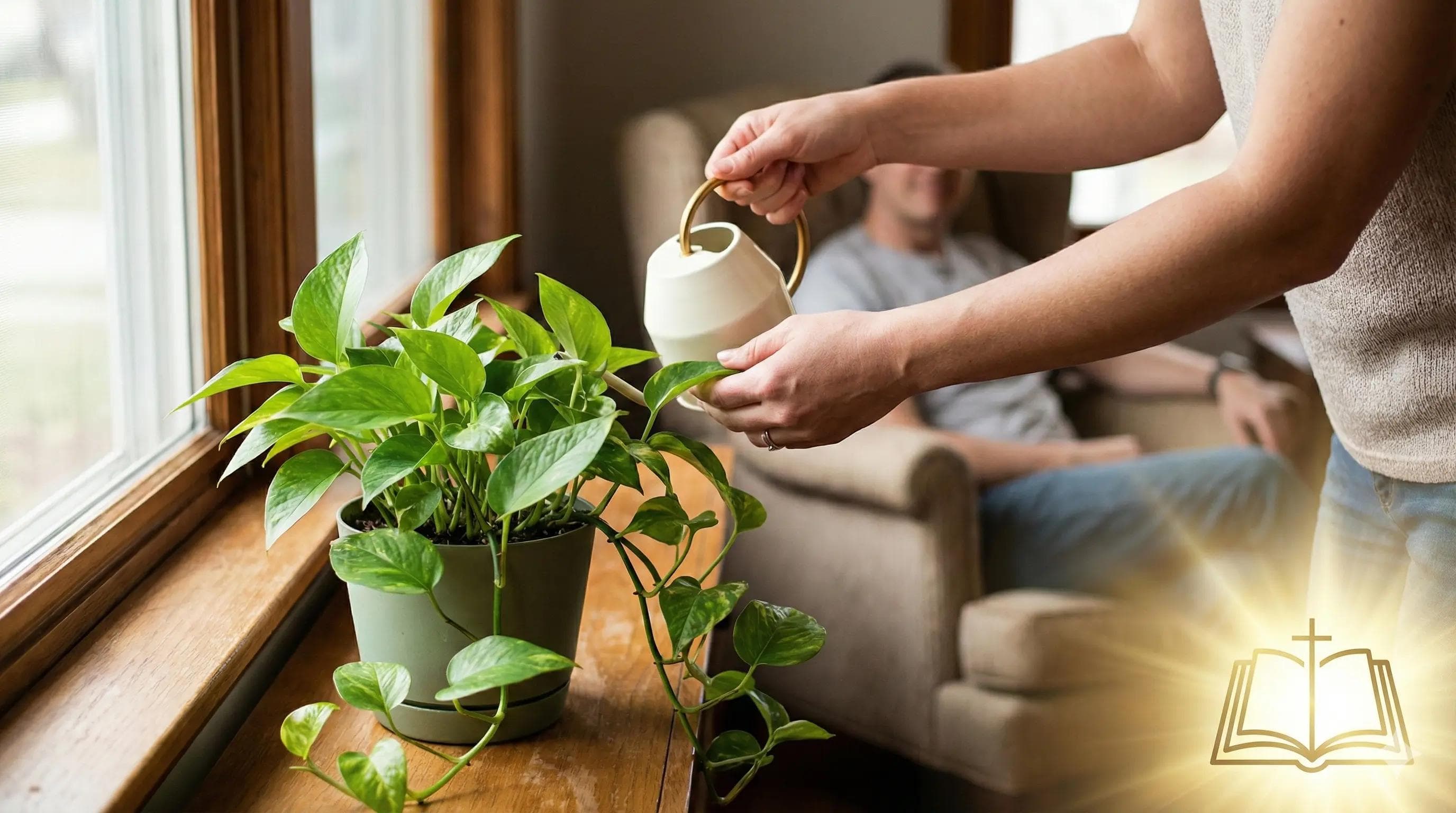
The breakthrough for my clients - and myself - often comes when we move the metaphor from the clinic to the soil. I keep an Epipremnum aureum (Golden Pothos) in my waiting room. It is historically resilient, yet I nearly killed it last year through what horticulturalists call hypoxic stress. In my eagerness to ensure it thrived, I watered it daily and moved it constantly to chase the light. I didn't understand that roots require oxygen just as much as they require water. By keeping the soil constantly saturated, I created an anaerobic environment where the roots literally suffocated.
This is the exact biological parallel to codependent over-functioning. When we "over-water" our relationships with unsolicited advice, constant check-ins, and aggressive problem-solving, we create relational hypoxia. We rot the roots of the other person's resilience.
- Signs of Relational Root Rot:
* The other person withdraws: Just as leaves yellow and droop from over-watering, people shut down when overwhelmed.
* Lack of independent growth: If you solve every problem, they never develop the "root strength" (coping mechanisms) to handle stress.
* Resentment: You feel exhausted because you are doing the work of two people.
This brings a terrifying clarity to Paul’s words in 1 Corinthians 3:6: "I planted, Apollos watered, but God gave the growth." There is a divine division of labor that the "fixer" ignores. My professional and personal responsibility is limited to planting (speaking truth) and watering (offering presence). The growth - the cellular division, the timing of the bloom, the internal change - is strictly God’s department. Trying to force a flower open with your thumbs will only tear the petals; trying to force a human heart to change will only break the relationship.
The Protocol for "Hands-Off Husbandry"
Recovering from this dynamic requires what I call Differentiation of Self. This is the psychological capacity to be emotionally connected to others without being emotionally reactive to them. It is resigning from the position of "General Manager of the Universe." In my practice, I guide clients through a protocol of "Hands-Off Husbandry," which requires tolerating the discomfort of watching others struggle. Struggle is not a sign of failure; it is the necessary friction for growth.
When I am with a struggling friend now, or when I feel the urge to micromanage my family, I utilize a specific mental checklist to ensure I am nurturing rather than smothering:
1. Check the Soil: Am I intervening because they asked for help, or because I am anxious?
2. The Pause: Before sending the text or offering the solution, I wait 24 hours. Urgency is usually a symptom of fear, not love.
3. The Affirmation: I replace advice with presence. I say, "I trust you to navigate this," giving them the dignity of their own agency.
We must trust the Great Gardener with the timing of the harvest. By stepping back, putting down the fertilizer and the shears, and simply sitting in the garden, we allow the light to finally reach the soil. It is only when we stop casting our shadow over the people we love that they finally have the space to grow toward the sun.