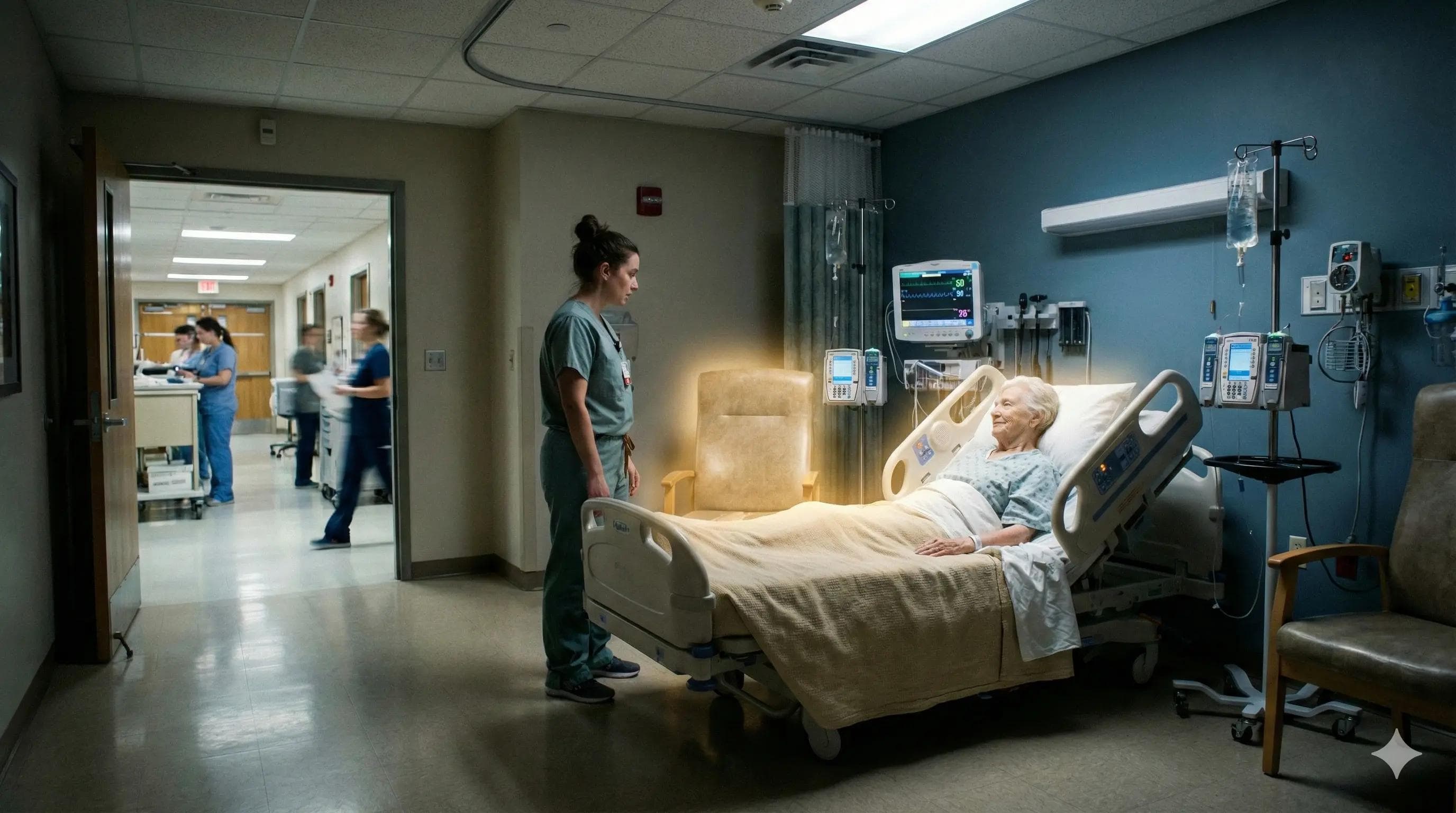
Location: Emergency Department, Trauma Bay 4
Subject: Unexplained Physiological Stabilization
The Friday night shift at our Level 1 Trauma Center was what we clinically refer to as a "Code Black" capacity scenario - a complete saturation of resources that pushes even seasoned medical professionals to their breaking point. By 2200 hours, the waiting room was holding forty-five patients with wait times exceeding six hours, and our diversion status was imminent. The ambient noise level was deafening: a cacophony of telemetry alarms, the hiss of portable oxygen tanks, and the shouting of a combatant patient in the psych hold. My assignment included the "step-down" hallway, a purgatory where we hold patients waiting for inpatient beds. Among the chaos was Mrs. Higgins, an 82-year-old female admitted with a diagnosis of Unstable Angina and Dyspnea (shortness of breath). Her initial workup was concerning; her EKG showed ST-segment depression, and her telemetry monitor was screaming a warning of Rapid Atrial Fibrillation with a ventricular response rate oscillating between 130 and 150 beats per minute. I had administered her scheduled Diltiazem drip twenty minutes prior, but her vitals remained stubborn: BP 185/110, O2 saturation hovering at a fragile 88% on room air. In an environment governed by triage algorithms and survival instincts, Mrs. Higgins was a high-acuity ticking clock. I grabbed her chart to document another vitals check, mentally preparing to page the Attending Physician for an escalation of care, perhaps even a cardioversion if she became hemodynamically unstable.
Stepping into Bay 4, however, induced a sensory shift that defied the physics of the department. The distinct, sterile roar of the ER - the slamming of Pyxis med-station drawers and the rhythmic beeping of IV pumps - didn't just dampen; it ceased entirely, replaced by a visceral heaviness in the air that felt strangely pressurized yet warm. As a nurse, you are trained to rely on clinical observation, and my immediate scan of the room presented data that contradicted the chart in my hand. Mrs. Higgins, who had been diaphoretic (sweating profusely) and clutching her chest just thirty minutes prior, was now lying in a semi-Fowler’s position, breathing with a visibly unlabored, eupneic rhythm. I immediately looked at the GE telemetry monitor, expecting a malfunction. The jagged, chaotic waves of Atrial Fibrillation were gone. In their place was a pristine Normal Sinus Rhythm at a rate of 72 BPM. Her blood pressure cuff cycled automatically as I watched: 122/78. This was not a gradual pharmaceutical conversion; clinically speaking, this was an instantaneous physiological reset. Mrs. Higgins wasn't looking at me, or the monitor. Her gaze was fixed on the scuffed beige distinct visitor chair positioned to the right of the gurney - a chair I knew to be empty. When I approached to check her IV patentcy, she gestured toward the empty space with a steady hand. "You can't see him, Sarah," she whispered, reading my nametag, "but he’s been holding my hand through the worst of the pain. He says the squeeze in my chest is gone now."
In emergency medicine, we rely on evidence-based practice, looking for the etiology of every symptom and the mechanism of every cure. Later that morning, the Hospitalist reviewed the telemetry strips and labs. Her Troponin I levels (cardiac enzymes indicating heart damage) had peaked and were trending down, and her repeat EKG showed no acute ischemic changes. The medical team labeled it a "spontaneous conversion secondary to delayed pharmaceutical efficacy," a fancy way of saying the meds finally worked. However, as the primary nurse at the bedside, I identified variables that the electronic medical record could not capture. The half-life of the medication administered didn't align with the suddenness of her stabilization, nor did it explain the sudden drop in cortisol-induced stress markers in her demeanor. I documented her vitals and discharge instructions, but mentally, I cataloged the incident under a different set of protocols.
Clinical Retrospective:
- Physiological Anomaly: Sudden conversion to Normal Sinus Rhythm without electrical cardioversion.
- Environmental Observation: Distinct auditory and atmospheric shift within the patient's room, isolated from the general ward chaos.
- Patient Outcome: Mrs. Higgins was discharged 24 hours later with a clean bill of health.
While my badge reads "Registered Nurse" and my training is in science, 12 years in the ER has taught me that patient advocacy sometimes involves acknowledging support systems that don't require a visitor pass. That night in Room 4, the medicine did its job, but I am professionally convinced that the "visitor" did the rest.