It bore a 32-cent “Midnight Angel” stamp - issued by the USPS in 1997 and not seen in common circulation for decades. The postmark was faint but legible: Cleveland, OH – June 14, 1998.
In my line of work, we deal with "lost wills" often, usually tucked inside freezers or taped under desk drawers. But mail delays of this magnitude are statistically anomalous. I recognized the handwriting immediately. It was the frantic, forward-slanting scrawl of my father, a man who died of a sudden myocardial infarction ten years ago. I didn't fall to my knees; I froze, my lawyer brain instantly trying to authenticate the document while my daughter brain struggled to process the timeline. This letter had been trapped in the machinations of the United States Postal Service distribution network for twenty-seven years. It had survived sorting facility upgrades, automated facer-cancelers, and the transition to intelligent mail barcodes, only to arrive on the day I was finalizing the liquidation of my assets and admitting that my life had gone completely off the rails.
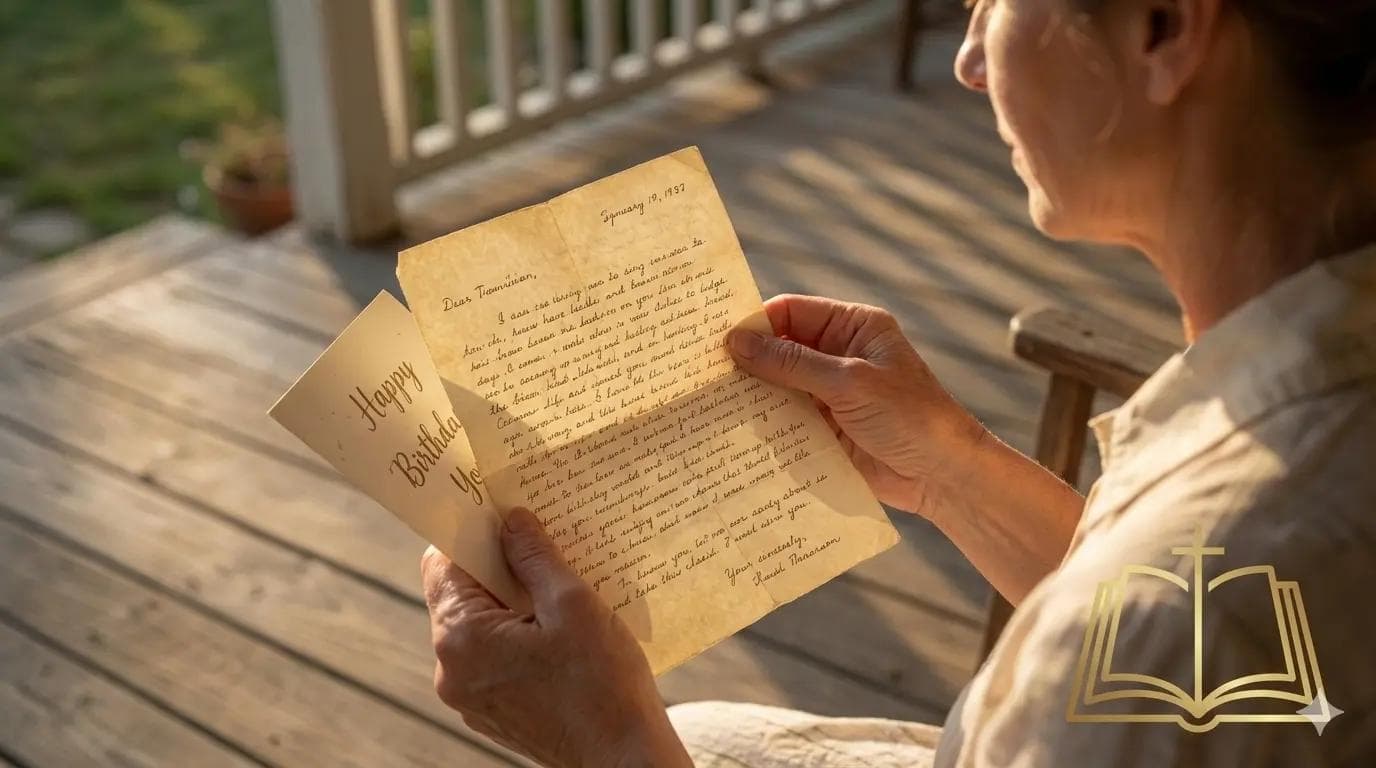
To understand the weight of this envelope, you have to understand the state of my affairs. I was in the middle of a high-conflict divorce. My ex-husband and I were warring over equitable distribution, and my practice was suffering because I couldn't focus. I felt like a fraud - counseling grieving families on stability while my own foundation crumbled. I sat on my porch steps, treating the envelope like forensic evidence. The glue had crystallized, snapping apart as I lifted the flap. Inside was a standard Hallmark card, the kind you buy at a CVS for $1.99, intended for my 30th birthday. I am now 57.
The text was brief. My father wasn't a man of grand speeches; he was a union pipefitter who believed in showing up, not showing off. But reading his words in blue ballpoint ink, preserved in a postal time capsule, hit harder than any legal closing argument I have ever delivered.
He wrote: “Becky, I know you worry about the benchmarks. You treat life like a case to be won. But I want you to know that I am proud of the woman you are, not just the verdicts you get. You are resilient. You are loved. Don't let the hard days harden you. Love, Dad.”
If I had received this in 1998, I would have dismissed it. I was young, arrogant, and climbing the corporate ladder. I would have viewed it as sentimental dad-talk. But arriving now? It defied the logic of the postal system. Mechanically, letters like this usually get stuck behind belts in older sorting machines or slip into "dead mail" bins, only to be dislodged during facility renovations. The fact that a postal worker manually reintroduced this into the mail stream rather than discarding it is a testament to the human element of logistics. It arrived precisely when I had convinced myself that my value was tied solely to my marital status and my net worth. It forced me to pause the litigation mindset and remember that my father saw my character, not my curriculum vitae.
In estate planning, we talk about "tangible personal property" - jewelry, cars, real estate. But this experience taught me the concept of the "Ethical Will," a non-binding document where you leave your values, stories, and love to your heirs. It is legally weightless but emotionally priceless. My father inadvertently left me an Ethical Will that arrived on a delay. Since that Tuesday, I have restructured how I advise my clients. I no longer just ask about their stocks and bonds. I ask them what they want their children to know when the noise of the world gets too loud.
Here is the professional advice I now give every client, inspired by a 32-cent stamp:
- Write the Letter Now: Do not rely on the postal service to perform a miracle 20 years later. Write letters to your children or beneficiaries today.
- Store it with the Trust: Place these personal letters with your estate documents. As your attorney, I can ensure these are handed over physically, bypassing the risks of mail carriers or lost emails.
- Focus on Character, Not Cash: Your assets will be spent. Your words on their resilience and your pride in them will act as a psychological anchor during their hardest times.
The post office may have failed on the logistics for two decades, but they succeeded in the delivery. That letter didn't fix my divorce or balance my checkbook, but it gave me back my narrative. I am not just a lawyer failing at marriage; I am my father's daughter, and I am resilient. And that is a legacy you cannot tax.