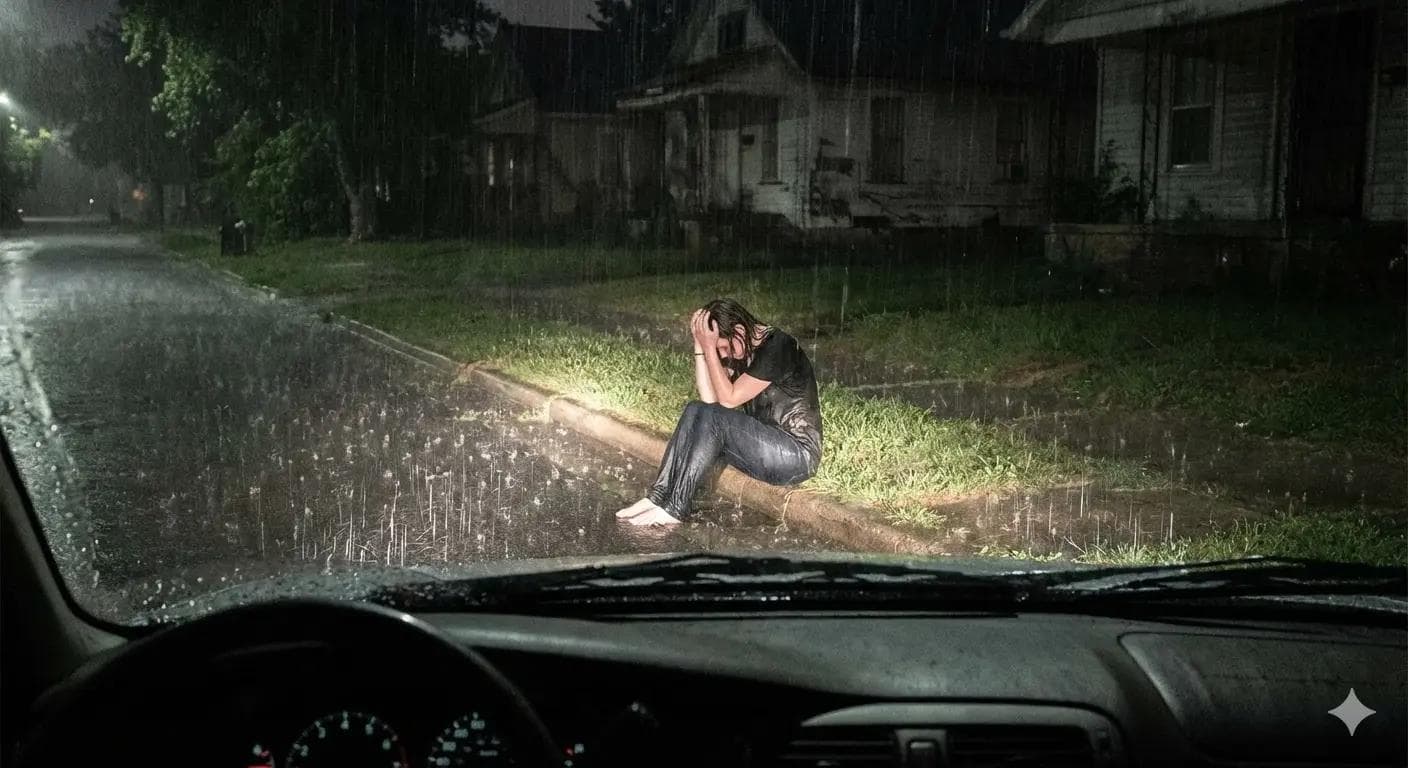
My initial risk assessment was purely defensive; I am not a first responder, I am a logistics guy, and this was an unlit, high-crime sector. But as I shifted into reverse, the "human factor" overrode the safety protocol. I couldn't leave a variable like that unresolved. I put the sedan in park, cracked the passenger window, and shouted over the roar of the wind. "Ma'am! Do you require assistance? Can I call a transport for you?" She looked up, and the despair on her face was unlike anything I have seen in a boardroom or a spreadsheet. She was soaked through, shaking violently, her eyes red and swollen. She stared at me with a bewildered intensity, as if I were a glitch in her reality. She didn't ask for money. She didn't ask for a ride. She simply wiped the water from her eyes and asked, her voice barely audible over the rain, "What is your name?" It was a non-standard question for a roadside emergency. Flustered, I reverted to protocol. "I'm Mark," I said. "Mark Stevenson." The reaction was immediate and visceral. She let out a sob that sounded like a physical structure collapsing. She buried her face in her hands, rocking back and forth. I realized then that this wasn't a traffic stop; it was a crisis point. I unlocked the doors. Over the next hour, sitting in my idling car with the heater blasting, she explained the data behind her breakdown. Five minutes before my lights hit her, she had walked out of her foreclosure - a house just a block away - and sat on the curb, ready to terminate her own timeline. She had issued a challenge to the universe, a specific, desperate prayer: "God, if you are real, you have to send someone to tell me I'm going to be okay right now. And just so I know it's you... make his name Mark."
In logistics, we deal with "Just-In-Time" (JIT) delivery, a strategy where materials arrive exactly when they are needed to reduce inventory costs. As she spoke, I felt a chill that had nothing to do with the damp Chicago air. I realized that my frustration, the missed exit, the GPS failure, and the gridlock on the highway were not errors. They were the supply chain of a miracle. If I had been efficient - if I had hit my green lights and made my turns - I would have been home dry and comfortable, and she would be gone. The mathematical probability of me getting lost in that specific sector, at that specific minute, bearing that specific name, is statistically impossible. I gave her the groceries I had in the backseat - staples I had picked up on auto-pilot - and we called a local shelter that I have since partnered with. That wrong turn disrupted my schedule, but it corrected my perspective. I spent years thinking life was about the straightest line between two points. I was wrong. Life is not random; it is routed. Sometimes, when our plans are delayed and our routes are blocked, it isn't an inefficiency. It is the Dispatcher sending us exactly where we are needed, right on time.